Reefer container
A reefer container is a refrigerated shipping container: an insulated ISO box with its own refrigeration unit in the front wall, which holds the temperature you set, frozen, chilled or warm, down to −25, −30 or −40 °C and up to +25 or +30 °C on the shipping lines' data sheets we read. It runs on electricity from a ship, a port, a generator set or a three-phase supply on land, and comes mostly as a 20 ft box or a 40 ft high cube.
Updated 22 Oct 2026Reefers priced this week: used from ₹5,50,000, new from ₹18,50,000 (20 October 2026). See the four reefers and their prices.
How a refrigerated container works
The unit in the front wall blows cold, or warm, air into the box under the load, through an aluminium floor of T-shaped bars about 60 mm high. The air rises through the cargo, gathers under the roof and returns to the unit, which cools it again, while insulated walls, roof and doors keep the outside heat out. A controller holds the set point and logs the temperatures, and drains in the floor let out the water of each defrost.
A reefer holds the temperature of goods that are already at it: it is not built to cool warm cargo, except very slowly (Hapag-Lloyd; West of England P&I). Frozen goods go in frozen, and fruit is pre-cooled before loading. A red line near the roof marks the highest the load may reach, since the air needs that space to get back to the unit. Fruit and vegetables go on breathing, so a vent on the unit lets in fresh air, and recent units also control humidity: Kuehne+Nagel gives 60 to 85 % relative humidity, down to 50 % on newer units.
Is a reefer a freezer?
It can be a freezer, a cold room or a warm room: the unit cools and heats, and the set point decides. Set to −20 °C, a reefer keeps frozen fish; set to +13 °C, it carries bananas. Its ISO code says it too: R1 means “mechanically refrigerated and heated”.
Reefer container temperature range
The range depends on the unit, not on the box. On the data sheets of CMA CGM, Evergreen, Hapag-Lloyd, Maersk, MSC, ONE and ZIM, reefers hold set points down to −25, −30 or −40 °C and up to +25 or +30 °C: some units stop at −25 °C, others reach −30 or −40 °C. Super freezers go down to −60 °C (Maersk) or −70 °C (Thermo King). That is why websites disagree on “the” range of a reefer: ask the seller for the model of the unit and the lowest temperature it has held.
What temperature should a reefer be set at?
It depends on the cargo: −20 °C or colder for frozen meat and fish, −23 °C or colder for ice cream, about −1 to +4 °C for chilled meat, cheese and apples, +2 to +8 °C for medicines, and about +13 °C for bananas.
| Cargo | Typical set point |
|---|---|
| Ice cream | −23 °C or colder |
| Frozen meat and fish | −20 °C or colder (tuna −20 to −25 °C) |
| Chilled meat | about −1.5 °C (poultry −1 °C) |
| Butter | 0 to +2 °C (frozen butter −20 °C) |
| Cheese | −1 to +4 °C |
| Grapes | −1 to 0 °C |
| Apples | −1 to +4 °C |
| Oranges | +3 to +8 °C |
| Dry onions | +4 to +8 °C |
| Potatoes (table) | +7 to +8 °C |
| Mangoes | +10 to +14 °C |
| Bananas | +13.3 to +13.9 °C |
| Chocolate | +10 to +18 °C |
| Medicines and vaccines | typically +2 to +8 °C (Maersk, March 2025) |
Reefer temperature chart: typical carrying temperatures from Maersk's commodity database, consulted on 22 October 2026. The shipper's instructions for each cargo come first; fruit and vegetables also need their fresh-air and humidity settings.
Chilled cargo needs its set point held closely: bananas held much below +13 °C suffer chilling injury. Medicines travel with a temperature log for the whole trip, which the controller of a recent unit records.
Reefer container sizes and dimensions
| Model | Inside L × W × H (mm) | Door W × H (mm) | m³ | Tare (kg) | Payload (kg) |
|---|---|---|---|---|---|
| 20 ft reefer container | 5,456 × 2,290 × 2,180 | 2,290 × 2,252 | 28.2 m³ | 2,920 kg | 27,520 kg |
| 40 ft high cube reefer container | 11,589 × 2,290 × 2,450 | 2,290 × 2,557 | 67.5 m³ | 4,505 kg | 29,610 kg |
Typical values: medians of the data sheets published by CMA CGM, Evergreen, Hapag-Lloyd, Maersk, MSC, ONE and ZIM, consulted on 20 October 2026. The markings on the doors give the tare and maximum gross of each box, and its CSC plate the maximum gross.
Outside, reefers have the size of dry boxes: 19′ 10½″ × 8′ × 8′ 6″ for a 20 ft reefer and 40′ × 8′ × 9′ 6″ for a 40 ft high cube. Inside, the insulation takes space: the lines’ data sheets give a 20 ft reefer 2,290 mm of width and 2,180 mm of height, against 2,352 × 2,393 mm in a dry 20 ft box, and 28.2 m³ to the dry box’s 33.2 m³. On those sheets the inside height of a reefer is lower than its door and its volume a little more than length × width × height: these are their figures, as published. The same lines run their 40 ft reefers as high cubes, whose extra foot gives back height: 2,450 mm inside, for 67.5 m³. Empty, a 20 ft reefer weighs about 2,920 kg and a 40 ft high cube about 4,505 kg, 640 kg more than a dry one. Every figure of each box, in mm and in feet, is on the 20 ft reefer and 40 ft high cube reefer pages.
Asia Containers does not sell containers. On 20 October 2026, used 40 ft reefers were priced from ₹5,50,000 (8 sellers) and used 20 ft ones from ₹6,50,000 (4 sellers): the unit makes most of the price, so the smaller box is not the cheaper one. New reefers are listed by few sellers, at far higher prices:
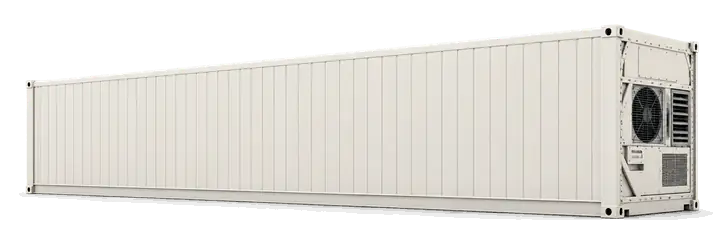 Illustration From₹5,50,000 8 sellers See prices and sizes Used 20 feet reefer container
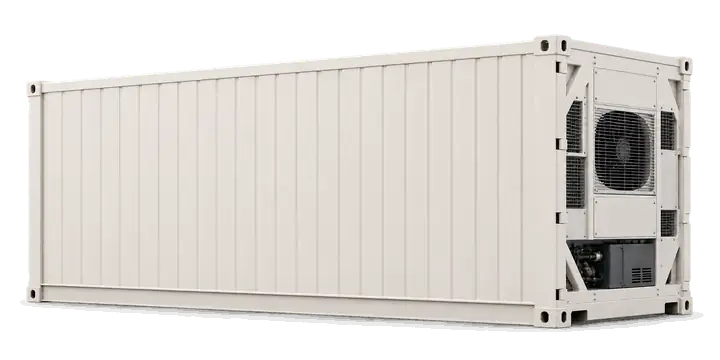 Illustration From₹6,50,000 4 sellers, too few for a firm price See prices and sizes New 40 feet reefer container (high cube) Illustration From₹23,00,000 1 seller, too few for a firm price See prices and sizes New 20 feet reefer container Illustration From₹18,50,000 1 seller, too few for a firm price See prices and sizes
Each page gives the asking prices of the week, the dimensions of the box and what to check before you pay, and sends your request to partner sellers who quote a delivered price. All sizes side by side are on the reefer container price page.
What is the ISO code for a reefer container?
22R1 for a 20 ft reefer, 45R1 for a 40 ft high cube and 42R1 for a standard-height 40 ft, painted next to the container number. The first two characters give the length and the height; R marks a thermal container, and R1 one that is mechanically refrigerated and heated (ISO 6346 type codes, as published by the BIC).
The reefer unit: Carrier, Thermo King, Daikin and Star Cool
The refrigeration unit fills the front wall of the box: compressor, condenser and fans on the outside, evaporator on the inside, and a controller with a display, an alarm list and a temperature log. Carrier Transicold, Thermo King, Daikin and Star Cool build most container units. They are electric: a container unit has no engine of its own, and where there is no plug a diesel generator set feeds it. The plate on the unit gives its make, model, year and refrigerant, which a service technician needs; the checks before you buy a used one are listed with the reefer container prices.
Which gas is used in a reefer container?
Carrier’s PrimeLINE units and Star Cool units are charged with R-134a. Newer units also take R-513A, which by Star Cool’s maker has less than half the warming effect of R-134a, or R-1234yf, and Carrier’s NaturaLINE runs on carbon dioxide (R-744). The plate on the unit names its gas.
Reefer power supply: voltage, plug and generator set
A container reefer runs on a three-phase supply without neutral: 380 to 460 V at 50 or 60 Hz on Carrier’s units, and at most 15 kW (18.75 kVA) by the GDV Container Handbook, the German insurers’ reference. It plugs into a 32 A, four-pin socket of the IEC 60309 type, the reefer socket of ports and ships, so a yard or a farm needs that socket on a three-phase connection.
What it draws depends on the set point, the cargo and the heat outside. Thermo King gives up to 11.5 kW for its Magnum Plus unit pulling down warm air at 38 °C outside, and 7.5 kW holding −18 °C (figures at 60 Hz). Over a day the unit cycles, so the GDV handbook plans on about 3.6 kW for a 20 ft reefer and 7 kW for a 40 ft one. It also notes that at 45 °C outside, a 40 ft box of bananas at +16 °C draws 7 to 8 kW, against about 4.2 kW for frozen cargo at −21 °C: fruit that breathes and needs fresh air costs more to keep than frozen goods.
At those planning figures, a reefer running round the clock uses about 86 units (kWh) a day for a 20 ft box and 168 for a 40 ft one, or some 2,600 and 5,000 units a month: multiply by the rate per unit on your electricity bill. Shade over the box and few door openings bring the figure down.
Where the grid fails, or does not reach, a reefer generator set clips onto the front of the box or hangs under the trailer: Thermo King’s SG-5000 delivers 15 kW. For a reefer kept as a cold room, see power and shade for a refrigerated storage container and site preparation and unloading.
Types of reefer containers
- Standard (integral) reefer: the unit is built into the box. This is the reefer sellers list in India.
- Controlled-atmosphere (CA) reefer: the unit also sets the oxygen and the carbon dioxide in the air, to slow the ripening of fruit (Maersk: 2 to 21 % oxygen, 2 to 20 % carbon dioxide).
- Super freezer: down to −60 or −70 °C, for tuna kept for sashimi.
- Porthole (Conair) container: an insulated box with two openings in its end wall, cooled by the ship’s or the terminal’s plant rather than by a unit of its own.
- Insulated container: no unit at all; the insulation alone slows the change of temperature.
- Non-operating reefer (NOR): a reefer whose unit stays off, used to carry dry cargo; its dimensions are those of the reefer.
Some “refrigerated containers” offered in India at a fraction of the price of an ISO reefer are panel cold rooms, made for storage on the ground: they carry no CSC plate and cannot be shipped.
Difference between a reefer and a dry container
A dry box keeps goods dry and locked, not cool. Choose a reefer only if the goods need a temperature: it holds less, it needs power and a technician near you, and it costs more. The typical asking price of a used 40 ft reefer was ₹6,00,000 on 20 October 2026 (8 sellers), against ₹1,90,000 for a used 40 ft high cube dry box (27 sellers). For goods that only need to stay dry, see the used containers.
Buying or renting a reefer in India
An exporter shipping chilled or frozen cargo normally takes the shipping line’s reefer with the freight booking: the line checks it before the trip and takes it back empty. Buying makes sense for a cold room on land, at a farm, a market, a shop or a warehouse: the reefers priced this week each have a page with a quote request, and the reefer container price page lists the checks to run before you pay. For a season, take a reefer container on rent.
Questions about reefer containers
What does reefer mean, and what is a CNTR reefer?
Reefer is the trade’s short word for a refrigerated container or truck, from “refrigerator”. CNTR is the usual abbreviation of “container” on shipping documents, so a CNTR reefer is simply a reefer container.
Can a reefer run on single-phase power?
Container units are built for three-phase power. In the listings we read, one seller offered a unit on 230 V single-phase: ask which supply the unit on offer needs before you plan the connection.
Reefer prices, rental and other containers
Published 22 October 2026. Sizes and weights come from the data sheets named under each table, consulted on 20 October 2026; prices from the reading of sellers' asking prices of 20 October 2026.