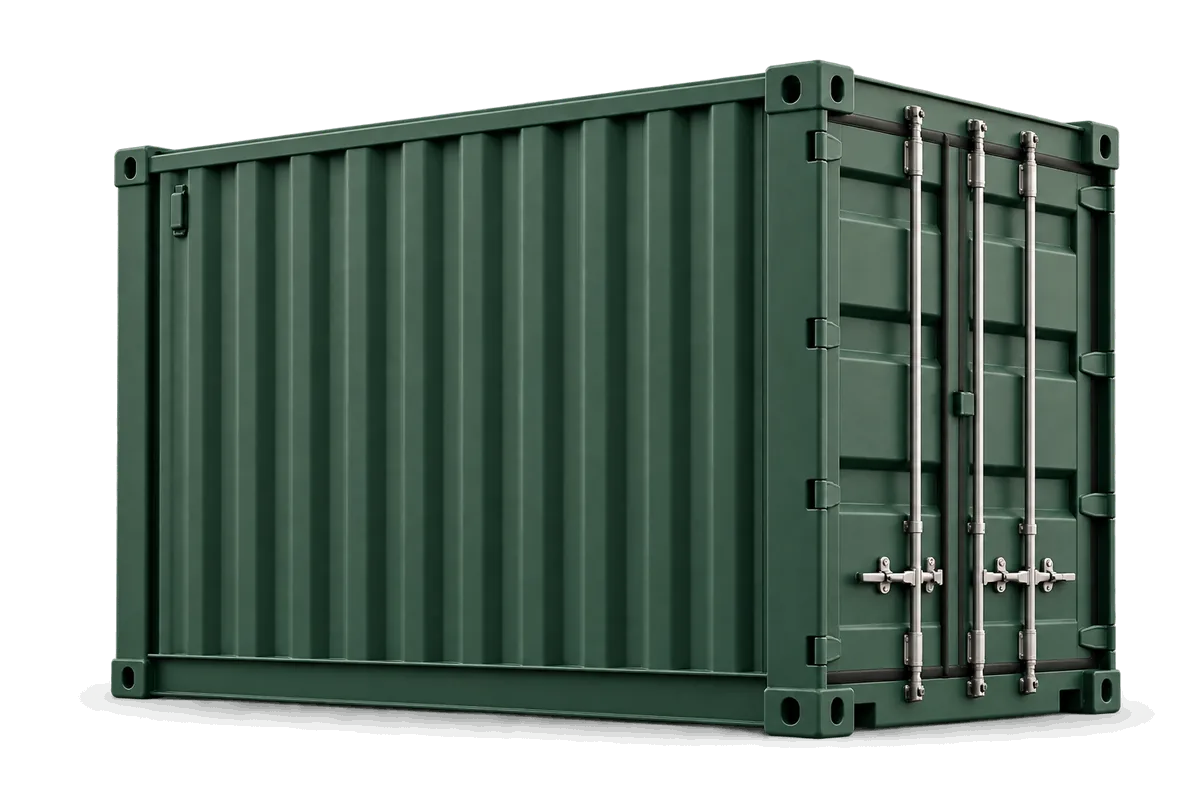
A 10 feet container is a short box built like an ISO container (code 12G1): 2,991 mm (9′ 10″) long outside, 2,831 × 2,350 × 2,392 mm inside (15.9 m³), with the same width, height and doors as a 20 ft box. It goes where a 20 ft box or its trailer cannot: a narrow plot, a shop front, a guard post, a generator or tool room. It costs more than its size suggests, and some 10 ft boxes are cut down from a 20 ft one. Partner sellers who cover your PIN code and have one quote it delivered.
One free request
Up to 5 delivered quotes, without calling every yard
-
Save time
One form instead of calling seller after seller. Partner sellers who cover your PIN code contact you with a price delivered to your site.
-
Pay less
Asking prices differ widely: for a used 20 feet shipping container, half of the 116 sellers we read on 20 October 2026 ask between ₹1,04,000 and ₹1,40,000, ₹36,000 apart. Several quotes show you where the low end is.
-
Checked sellers
Quotbox checks every partner seller when it joins: an active GSTIN, its company registration and PAN, its insurance, its yard or stock, and its years in business or references. A justified complaint gets a partner removed.
Free and without obligation: you choose the seller and pay them directly. How it works
10 feet container price: why it costs more than a 20 ft
A used 10 ft box is priced from ₹1,67,000 in our survey, and half of its 5 sellers on IndiaMART ask ₹1,67,000 or less (20 October 2026). A used 20 ft box is priced from ₹1,04,000, typically ₹1,20,000, with 116 sellers. Half the length does not halve the price:
- Few are sold. None of the 8 shipping lines whose data sheets we read lists a 10 ft box, so few retired 10 ft boxes reach the used market, as 20 ft ones do every year; our 10 ft figures come from manufacturers, leasing companies and dealers. On 20 October 2026, 5 sellers listed a used box clearly 10 ft long, against 116 for a used 20 ft one.
- The same frame on a shorter box. A 10 ft box has the same pair of doors, the same corner posts and castings and the same end frames as a 20 ft box; only its side walls, roof and floor are shorter.
- A cut-down box carries the cutting. A 10 ft box cut from a 20 ft one starts as a 20 ft box, then gets a new end welded in: the seller’s work is in the price.
If length is not what limits you, a used 20 ft box gives about twice the space (33.2 m³) for less. If the plot is the limit, the 10 ft box is the one that fits.
Cargo-worthy
Sound walls, roof and floor, doors that seal: it can still go to sea.
- Structurally sound: no holes, frame and corner posts straight.
- Doors, locking bars and seals working; floor sound.
- Normally a CSC plate with a valid examination date, so it can still be shipped or stacked.
- Paint faded in places, dents and scuffs, patches of surface rust.
Check before you pay: the CSC plate and its last examination date, the floor near the doors, and the light test inside with the doors closed.
Wind and water tight
Keeps wind and rain out, but would not pass a shipping survey.
- No holes: the box keeps wind and rain out.
- Visible dents, surface rust at the foot of the walls and around the door frame.
- The floor may be worn or patched, the frame may carry repairs, the CSC approval may have lapsed.
- Right for storage on the ground, not for shipping goods by sea.
Check before you pay: the roof from above for dents that hold rain, the floor from inside, and the light test with the doors closed.
A grade is the seller's word, not a certificate. Container grades explained · How to inspect a used container
Used 10 ft shipping container: factory-built or cut down?
For storage on your own land, either kind will do; the difference matters if the box will ever go to sea. A factory-built 10 ft box is one body, with no weld seam across its walls, roof and floor, and a CSC safety-approval plate of its own. A cut-down box is part of a 20 ft box closed with a welded end: a new end wall on the part that kept the doors, or a new door end on the other part.
Under the International Convention for Safe Containers (CSC), as amended by the IMO in 1991 (resolution MSC.20(59)), a container modified in a way that voids its original approval must lose its safety-approval plate; if the change is structural, the box has to be declared to the Administration or to an approved organisation, which can test it again before recertifying it. The Indian Register of Shipping requires re-certification after a modification for the boxes it certifies. Whatever grade a seller writes, “cargo-worthy” included, a cut-down box is not fit for the sea until it is recertified: ask for the papers if you will ship it.
Ask which kind of box it is, and for photos of:
- both ends, inside and outside: a weld seam right across the walls, roof and floor, next to the doors or next to the end wall, marks a cut-down box; check it for rust and gaps;
- the CSC plate, which also gives the date of manufacture, and the container number on the doors;
- the roof and the floor along any weld.
Beware too of listings where “10 ft” is the height or the width of a cabin (“20 × 10 ft”, “height 10 ft”): that is a prefab cabin, not a 10 ft container. Container or porta cabin tells them apart.
10 feet container size and weight
| Measure | Size |
|---|---|
| External size (L × W × H) | 2,991 × 2,438 × 2,591 mm9′ 10″ × 8′ × 8′ 6″ |
| Internal size (L × W × H) | 2,831 × 2,350 × 2,392 mm9′ 3½″ × 7′ 8½″ × 7′ 10″ |
| Door opening (W × H) | 2,340 × 2,280 mm7′ 8″ × 7′ 6″ |
| Floor area inside | 6.7 m²72 sq ft |
| Inside volume | 15.9 m³562 cu ft |
| Tare weight (empty), range 1,200–1,700 kg | 1,300 kg |
| Payload (typical) | 8,960 kg |
| Maximum gross weight | 10,160 or 12,000 kg, depending on the box |
Typical values (median of 6 data sheets published by a leasing company, a seller in Australia, a seller in Mexico, a seller in Spain, BULLBOX and Sea Box, Inc., 20 October 2026); feet and inches rounded to the nearest half inch. The markings on the doors give the tare and maximum gross weight of each box, the maximum gross also being on its CSC plate: a box rated higher carries more, its maximum gross weight minus its tare. Every size in feet, cm and mm: container sizes and dimensions.
Delivering a 10 ft container: vehicle, unloading and base
The used 10 ft boxes listed on 20 October 2026 stood in Delhi NCR and Chennai: elsewhere, the box may travel some distance, so compare delivered prices, and see the delivered price estimate for the trucking. Ask the transporter which vehicle can reach your site, a 20 ft trailer or a smaller truck, and how the box will come off, by crane, side-lifter or a truck-mounted crane (its weight is in the table above); then check that the quote includes it.
Set it level on firm ground or on blocks under the corners. Each door leaf is about half the door opening (2,340 mm) wide, so leave about 1.2 m clear in front of the doors. In front of a shop or on a public road, ask your municipality first: permission to place a container. Site preparation and unloading explains the base.
10 feet container for sale in India: questions before you buy
What is the price of a 10-foot container in India?
From ₹1,67,000 for a used one in our survey; its 5 sellers asked ₹1,20,000 to ₹2,90,000, and half of them ₹1,67,000 or less (20 October 2026). New 10 ft boxes are built too: if you need a new one, say so in your request. A “10 ft container” offered far below these prices may be a cabin or a box in poor condition: ask whether it is a steel shipping container with a CSC plate and a container number. Delivery and unloading come on top, and GST (18%) too when the price is quoted without it: see GST on shipping containers.
What are the dimensions of a 10 ft shipping container?
Outside, 2,991 × 2,438 × 2,591 mm (9′ 10″ × 8′ × 8′ 6″), about 3 m × 2.4 m × 2.6 m. Inside, 2,831 × 2,350 × 2,392 mm, 6.7 m² (72 sq ft) of floor, on the 6 data sheets we read. The door opening is 2,340 × 2,280 mm, as on a 20 ft box. A cut-down box may not match these figures exactly: measure the one you are offered.
How much does a 10 ft container weigh?
About 1,300 kg empty. Its doors are marked with its tare and its maximum gross weight, 12,000 kg on the heaviest-rated boxes of the data sheets, and its CSC plate repeats the maximum gross (container weight); a cut-down box has no valid plate until it is recertified.
Can a 10 ft container be a site office, a cabin or a shop?
Yes, a small one: about 6.7 m² of floor is enough for a guard cabin, a ticket booth or a small kiosk. Bare steel gets very hot in the sun: someone working inside needs insulation and a vent or a window, and each opening cut in the steel needs a frame. For a ready-made unit, see container offices and container shops and container cafés; a porta cabin may cost less for an office that never moves.